Showing posts with label South Africa. Show all posts

Tuesday, September 8, 2009

Above All Else. Image.


13H30 is 14H00 on Billy’s R68 000 birthday present watch bought for him by his boss. For a PA, he is late for our meeting! He also thought it a good idea to get a little high-fashion shopping done, whilst we chatted. Billy’s profile reads: PA to the CEO of ACG International, a global network that works with the rich and fabulous”.


Through an associate, we met Billy at a millionaire’s party that he organized a while  ago in the luxurious and decadent suburb of Houghton, Johannesburg. He has agreed to squeeze  us into his busy schedule  as a favour to a friend of a friend (only the rich!).  Billy is really living it up at 28, working for a Luxury Lifestyle Private Aviation company that hosts some of the world’s most notorious dignitaries. He has met Mandela, Jacob Zuma, Richard Brandson, Oprah, Patrice and some royal families.


Billy knows a lot about the rich and fabulous. He told us that the richest of the rich still love flashing their wealth, they still love showing off their possessions, and, with his portfolio of  South African clientele, those in the money game were still spending their money even in the recession.


“People are still buying diamonds, hosting parties and investing in art, I tell you. A significant amount of individuals are still buying luxurious goods because now more than ever they believe that the purchase of luxury goods is a significant investment.”


These individuals want to look good and even though they may be a little knocked by the crisis, they are still taking risks to maintain their image.


In the August issue of DRUM we read about the ZULU princess wedding worth millions. With her father earning more than 10 million a month in state compensation, the little princess royalty went all out for her wedding, inviting the who’s who of the entertainment industry, royalty clans, and media. As if that was not enough her gown alone was said to be estimated at R120 000, imagine how much more all her other wedding costs were.


The rich are spending. All in the name of image. Tumisho Masha recently threw his 34th birthday party, and gave his guests gifts. Playing the image game, rather than the saving game in this “economic crisis”. Perhaps losing their image costs for more than losing their money.


But, if you want to play, you must also pay. One local rich celebrity is paying immensely is Khanyisile Mbau, ex-wife to business mogul Mandla Mthembu. At 23, the flamboyant madam has fallen from grace because she and her husband have burnt through most of their millions all whilst thinking “this recession thing” is not really that real.


In the South African’s richville, we guess even though the world is in recession, having money comes with huge burdens because image becomes an integral part of the game. And most of these people have to forget the immediate problem of the recession and try to please their peers and society so that they do not look like they are struggling. In the worst case scenario of Khanyi, how do they recover their money together with their image?


Money is an  emotional game that leaves those who fail to play effectively, feeling unworthy and gloomy once they lose most of it.


So the rich will keep spending unwillingly because they want to seem as though they can maintain their lifestyle. The recession has really knocked more than their balance sheets, it is playing havoc with their image.


Opportunity: Help Them Maintain Their Image / Live Out Loud  

- Adene

Smart Thinking


“It was obviously made by, you know, a gay, because its just beautifully made with attention to detail. Even the buttons are covered!”


Wendy is telling the story of how she just found the cutest little jacket for her dog, Onion, at the Charity Shop, after she’d taken him to the parlor for a “little pedi”.


Wendy is proud of her savvy. She can skillfully combine 

luxuries with unashamed visits to the local charity store, which she also sees as supporting a good cause, while saving money.


“Your generation doesn’t know how to find a deal. We never pay more than R30 for a bottle of wine. Although of course we buy a few cases at a time… you know…”

Wendy and her friends aren’t negatively affected by the recession. In fact, they have been able to take advantage of the current state of affairs by investing in cheap shares, taking advantage of holiday deals overseas and by ‘switching’ holiday homes with Europeans.


“The recession has done wonders for my business. I own four Montessori schools and because a lot of woman are going back to work we have had a 30% 

increase in enrollment this year.”


“We have had some wonderful opportunities by switching our barge in France with Europeans who have houses all over the world. We had a lovely skiing holiday in Austria, we stayed in a country manor in England and we had a holiday by the sea in Australia. All without paying for accommodation.”


Whilst Mike is less flashy than Wendy and her friends, he too, 

has seen the recession as a positive. A way to filter out the bad, and make way for the new. In fact, Mike refers to the recession, as “nothing more than the common cold”. His life as he knows it, has not stopped. He is not hospitalized or re-evaluating his will. He has by no means been reckless enough to have the “cold” morph into something like “pneumonia”.


And, he and his management team seem to have benefited from the recession.


Having recently completed a management buy-out, the recession helped us filter out any unnecessary spending. The limping-antelope-divisions were sacrificed so that the stronger herd could remain. Our timing was perfect. We knew high-risk before we were really tested by it. We’ve been cost-cutting cautious, which made us welcome the recession. We were ready to take it on.


This market knows that success does not come easily – “you have to be proactive and work hard”, says Tony, the CEO of an IT company and self-made billionaire, the world is not there to pay me any favors, and the recession can try to steal my worth, I will just have to work harder to outsmart it.


Unlike the BEE market in South Africa, they don’t believe in quick fixes and pots of gold at the end of the rainbow. They are realists. Their ethos is rooted in their experiences of having lived through the likes of petrol rations, water restrictions as well as interest rates of 20%. They are the children of the parents who lived through the Great Depression. They know they have to be smart.  Perhaps it’s about rewarding their “deal-finding” abilities with certain luxuries that they may find guilty purchasing otherwise? Perhaps, this is the generation that grew up, where reward was given for hard work, not easy gaps and quick fixes.


Opportunity: Give Them Deals That Make Sense. Not Too-Good-To-Be-Trues.

- Adene

2010 - The Hope of South Africa


Patrice Motsepe, one of South Africa’s first black people to be listed on the Forbes International top rich people in the world has recently bought Sundown’s Soccer Club. Sitting at number 500 on the Forbes list, this is a milestone for most South Africans. It gives hope to those who seek affirmation for their hard work.One could argue this is a strategy to get back into the game, and a quick fix solution to the millions he has lost as a result of the recession. Patrice is not the only one invested in the African Game. 

Government has employed many other small companies to build stadiums and transport tourists.This is all good and well for many who have not known what it means to be part of a huge economical project. Individuals whose companies have been registered as builders and organizers are earning more than R100 000 into their personal pocket now - this quickly classifies most of them as high-income earners, with most believing, and acting, as the rich do.

“While this seems all good and well in practise, it is a ticking bomb” says Palesa Ncube, Economist for Standard Bank. The thing is right now, these 'rich' people are earning far more than they are accustomed to. They believe that the money they are making with their contracts will secure them in the future, which is not necessarily true.  They have pushed up their income brackets far too quickly, which will soon end after 2010. Outspending on luxury items, without thinking about the future.”

In a recent radio show on South Africa’s leading radio broadcaster SA FM, Tim Modise spoke about 2010 and all the things planned. He spoke about how life changing it was for most people to move up from middle-income earners to high-income earners in such a short space all because of 2010.

In most South African minds, 2010 is the light at the end of the tunnel. With FIFA’s support, the estimated turnover expected into the country for the event would be  between 40 000 to 500 000 people. This number is set to boost the economy significantly as well as highlight South Africa to the rest of the world.

With this said, we started asking South Africans about their thoughts after 2010, and it seems as though no one has an answer, or rather no one has planned beyond that.

Merchais runs a refurbishment company that is largely contracted to the Government for the 2010 stadiums project. Since 2007 he has been making an estimated 2, 3 million worth of business yearly.

 “It hit me the other day that I should stop spending my money supporting this lifestyle I have created for myself since this contract. The recession is real, because I don’t know if I will ever make as much money as I have made from this one contract after 2010. Business is almost finished and we now have to fight for new contracts after 2010”

This is a hard truth in Merchias and so many newly found wealth individuals. So whilst many are weathering the recession by capitalizing on 2010, the question we need to ask: Are they ready for what lies beyond the game?

Opportunity: Help Them See Past 2010.

- Adene

What Recession?

Recession! What recession? This is the kind of response you might get from South Africa’s BEE individuals (Black Economic Empowerment). They are the newly found rich segment in South Africa. They are the ones who found the golden pot at the end of the rainbow after 1994 once the democratic government came into power. They are South Africa’s black diamonds”.


And they are spending. The latest findings of the UCT Unilever Report shows that, despite the recession, this markets’ spending power has grown by 39%, from R150 billion in 2007, to R250 billion to date.


Solly is just such a guy. He is rich. He is sleek. He’s an eternal optimist. And he knows what it means to fight for what you want. So what we might call a recession, he calls a “social struggle”. An opportunity to roll with the punches and come out stronger as a result. “I grew up in the struggle, I laugh in the face of what you call a crisis”


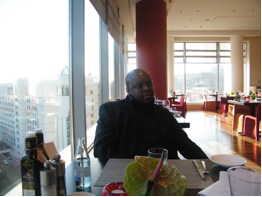
We met him at the Radisson restaurant situated in one of South Africa’s most prestigious hotels in Sandton City. He arrived, dressed in a black shirt and sleek designer black jacket, jeans and very shiny shoes. Waving keys to a  R2,4 million Bentley, he quickly tells us that this is his new investment.  He is thinking of buying this “baby” to add on to his other high profile portfolio of cars parked in his garage. I am an optimist, he tells us I believe that the recession is a state of mind he says with a look of determination on his face.


Solly is not the only rich guy who shares the same sentiments about the recession. 

Bonnke, a self-made

 man, struggled through life to become the man he is today. A man who knows what it means to grow up in a “recession / struggle” all his life says this is just another opportunity for me.


The same is true for other high-flying BEE people.


In an email we got from Thami, a Senior Sales Trader for an international company, he writes about his friend who recently went on holiday in Greece. In the long conversation emails we had, he sarcastically writes in huge bold letters:


They are happily going about their holidays, buying new cars and expensive furniture for their houses because they feel that if it is not directly affecting them, they should keep spending.


“Buying a couch worth R120 000 is easy for these people says a sales executive at one of the most prestigious and high-flying furniture stores in Johannesburg. With commission of at least R50 000 a month, it means Sipho has to sell furniture worth just over a million a month to make this income and Sipho tell us, doing this, is quite easy.


“The months have been good thus far. In a month I know I can make that much because these people are buying. They do not mind spending that much money, even in the recession.”


The truth is that these BEE guys are still living quite comfortably and spending quite freely. Perhaps they feel they deserve it. Perhaps they made smart decisions. Perhaps the recession really is small when compared to a life filled with struggle.


One thing is for sure, they are tenacious and one can only be humbled by such resilience.


Opportunity: Recognize Them For Their Tenacious Spirit. 

- Adene

From the Top: South Africa


As the world watches, banks and companies listed on the stock exchange spiral out of control, but South Africans are still shopping comfortably, throwing parties and even finding new opportunities that seem contradictory to recessionary behavior.


For us, it was interesting to see what the big players in the market were doing with their money. It took patience, trust and perseverance to get most people to talk about their cash to us – real and imagined, the losses and the gains.


We really had to immerse ourselves in their world. Hang out in the places they hang out. Lunch with the PA’s that run their world. Drink tea with the mothers that shaped their world. Listen to the economists and investors that predict their world. The husbands and the wives that are their world.


We wanted to find out what their stories were in the face of the economic chaos. How were they maintaining their image, their lifestyle and most importantly, still playing the money game in a world that was “Down the Tubes” as the above article in The Times of May ’09 suggests?

- Adene